

Type K vs Type N Thermocouples: Core Differences for High-Heat Accuracy
When comparing Type K vs Type N thermocouples, engineers must evaluate how these sensors generate voltage and how their internal crystalline structures respond over time to prolonged thermal exposure. Both are categorized as base-metal thermocouples, meaning they utilize common, cost-effective alloys rather than noble metals like platinum or rhodium. Because they are more affordable than noble metal sensors, they are deployed extensively across heavy industries, including steel processing, aluminum casting, power generation, and commercial heat treatment.
However, treating Type K and Type N as interchangeable legacy configurations is a common operational mistake. While Type K has traditionally enjoyed ubiquity due to its long history and low upfront cost, Type N was engineered specifically to address the fundamental chemical and physical failure modes inherent in Type K chemistry.
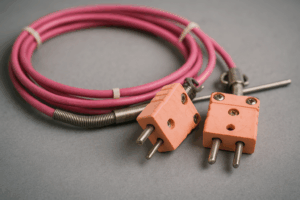
To choose between them effectively, industrial operations managers and procurement buyers must look beyond the initial purchase price and analyze the total cost of ownership, recalibration frequencies, and long-term measurement accuracy.
Analyzing Thermocouple Temperature Limits and Material Compositions
The performance differences between these two sensor types stem directly from their metallurgy. Every thermocouple relies on the Seebeck effect, where temperature variations across two dissimilar metal wires generate an electromotive force (EMF) or millivolt signal. The specific alloys used dictate both the operational environments and the absolute thermocouple temperature limits each sensor can endure.
Type K Material Composition and Operational Limits
- Positive Leg (KP): Chromel (approximately 90% Nickel, 10% Chromium)
- Negative Leg (KN): Alumel (approximately 95% Nickel, 2% Aluminum, 2% Manganese, 1% Silicon)
- Temperature Range: Type K thermocouples operate across a wide nominal range, typically from -200°C to +1,260°C (-328°F to +2,300°F).
While Type K is highly versatile, operating it continuously at its upper thermocouple temperature limits in oxidizing environments causes rapid wire oxidation, leading to a permanent change in the wire’s electrical properties and an inaccurate output signal.
Type N Material Composition and Operational Limits
- Positive Leg (NP): Nicrosil (approximately 84.4% Nickel, 14.2% Chromium, 1.4% Silicon)
- Negative Leg (NN): Nisil (approximately 95.5% Nickel, 4.4% Silicon, 0.1% Magnesium)
- Temperature Range: Type N thermocouples cover a nominal range of -270°C to +1,300°C (-454°F to +2,372°F).
By increasing the Chromium content to over 14% and integrating precise amounts of Silicon into both legs, the developers of Type N created a base-metal sensor with significantly higher structural stability. The presence of Silicon creates a continuous, protective diffusion barrier of silicon dioxide (SiO2) on the surface of the wires. This layer improves oxidation resistance at elevated temperatures compared to Type K.
The Root Causes of K-type Thermocouple Drift
One of the most persistent issues confronting quality assurance managers in thermal processing facilities is K-type thermocouple drift. This phenomenon manifests as a progressive, unpredictable shift in temperature readings over time, even when the actual process temperature remains constant. There are two distinct physical mechanisms responsible for this drift:
Short-Range Ordering (SRO)
Between the temperatures of 200°C and 600°C (392°F to 1,112°F), the Nickel and Chromium atoms within the Chromel leg undergo a localized atomic migration, forming a highly ordered crystalline lattice structure. This structural transformation alters the Seebeck coefficient of the wire. If a temperature gradient exists across this altered zone, the sensor generates an erroneous EMF signal, resulting in measurement errors of up to 4°C to 5°C. This phenomenon induces a hysteresis effect; as the sensor cycles above and below this critical thermal zone, the measurement error fluctuates unpredictably.
Green Rot (Selective Oxidation)
In low-oxygen, reducing, or stagnant atmospheres, such as those found in specific vacuum furnaces or sealed protection tubes, the Chromium in the Type K positive leg is oxidized preferentially while the Nickel remains unaffected. This forms a greenish oxide coating and depletes Chromium from the remaining base alloy. Because the alloy composition has changed, the voltage output drops sharply, causing the sensor to read much lower than the actual temperature.
Type N thermocouples virtually eliminate both of these vulnerabilities. The increased Chromium and Silicon content stabilize the atomic lattice, suppressing Short-Range Ordering. Furthermore, the tenacious silicon dioxide film prevents the selective oxidation that causes Green Rot, making Type N structurally stable across its entire operating envelope.
Primary Type N Thermocouple Advantages in Thermal Processing
For high-precision industrial processing, upgrading to a Type N sensor provides distinct operational improvements. The key Type N thermocouple advantages include:
Specifying Industrial Temperature Sensors for Harsh Environments
To maximize the benefits of Type N thermocouple advantages, engineers must also look closely at the external protective architecture of the sensor. High-quality industrial temperature sensors rely on robust insulation and sheathing to isolate the delicate thermoelements from mechanical damage, corrosive chemical gasses, and high pressure.
Mineral-Insulated Metal-Sheathed (MIMS) Engineering
For severe industrial environments, Mineral-Insulated Metal-Sheathed (MIMS) thermocouples provide the highest level of protection. In a MIMS configuration, the Type N or Type K wires are embedded inside compacted, high-purity Magnesium Oxide (MgO) powder insulation, all contained within a robust outer metal sheath.
When configuring MIMS sensors, matching the sheath alloy to the process atmosphere is vital:
- Inconel 600 Sheaths: Excellent for oxidizing environments and widely paired with Type K sensors.
- Nicrobell or Pyrosil Sheaths: Specifically engineered to match the thermal expansion characteristics and high-temperature capabilities of Type N elements, providing unparalleled longevity up to 1,250°C.
Step-by-Step Migration Protocol for Plant Instrumentation
If your facility decides to transition from Type K to Type N to eliminate drift issues and reduce maintenance overhead, it is critical to realize that this is not a simple swap. Because Type K and Type N have completely different Seebeck coefficients, they generate different millivolt outputs at identical temperatures.
To execute a successful sensor migration, follow this integration protocol:
- Reprogram the Controller or PLC: You cannot connect a Type N sensor directly to a Type K controller input. Doing so will cause severe temperature reading errors. You must enter your instrument or PLC configuration menu and update the sensor input type from K to N.
- Replace the Extension Wire: Thermocouple extension wire must always match the thermocouple type. Type K systems use yellow ANSI-coded jackets and wires, while Type N systems require orange ANSI-coded extension wires. Using Type K extension wire with a Type N probe introduces a new material junction, corrupting your data loop.
- Verify Calibration Standards: Ensure your internal quality control procedures and calibration lab equipment are updated to test and certify Type N curves according to ITS-90 standards.
Selecting between Type K vs Type N thermocouples requires balancing upfront material costs against long-term process repeatability. While Type K remains a reliable, cost-effective workhorse for low-temperature, non-critical, or purely oxidizing environments, Type N represents a major technological leap forward for high-temperature, tight-tolerance industrial applications.
For over a century, Cleveland Electric Laboratories has been a trusted leader in custom industrial temperature sensor manufacturing and precision engineering. Our state-of-the-art testing facility includes an accredited certification lab complying with ISO/IEC 17025 and ANSI/NCSL Z540 standards, capable of handling precise temperature calibrations ranging from -320°F up to 2,300°F.
Whether you need advanced MIMS assemblies, specialized vacuum furnace thermocouples, or expert engineering advice on migrating your plant instrumentation to Type N, our technical staff is ready to assist. We specialize in building tailored, robust sensing solutions designed to thrive in the harshest industrial environments.