

Thermocouples 101 – The Complete Guide to Industrial Temperature Sensors
Introduction: What Is This Guide?
Thermocouples are widely used temperature sensors in thermocouple industrial applications because they are durable, reliable, and capable of measuring an extensive temperature range across demanding environments. They are commonly applied in sectors such as aerospace testing, heat treatment, and power generation, where accurate thermal monitoring is essential for process stability and safety. Important performance factors like thermocouple time constant affect how fast the sensor reacts to temperature fluctuations, which is critical in fast-changing systems, while thermocouple precision and accuracy ensure dependable readings that support quality control and operational efficiency. These combined characteristics make thermocouples a preferred choice for industrial temperature measurement.
This guide provides a structured, high-level overview of thermocouples—their function, types, performance characteristics, and applications. It is intended for engineers, technical managers, and procurement professionals seeking a foundational understanding of thermocouple technology and its practical use in demanding environments.
In This Guide, You’ll Learn:
- How thermocouples work (Seebeck effect, cold junctions)
- Differences between common thermocouple types
- Factors affecting lifespan and failure modes
- Industry-specific applications and requirements
- The importance of calibration, traceability, and customization
A thermocouple is a temperature sensor consisting of two dissimilar metal wires joined at one end, forming a measuring junction. When this junction experiences a temperature change, it generates a small but measurable voltage—a result of the Seebeck effect. This voltage correlates directly to temperature and can be interpreted by instrumentation such as controllers, data loggers, or PLCs.
Basic Construction:
- Measuring Junction (Hot Junction): Where the two metals are joined and exposed to the process temperature.
- Reference Junction (Cold Junction): The opposite end of the circuit, typically maintained or compensated for at a known temperature.
- Conductors: Made from specific alloys, chosen for predictable thermoelectric properties.
- Sheath or Protection (Optional): A metal or ceramic outer layer that shields the sensor from mechanical damage or chemical exposure.
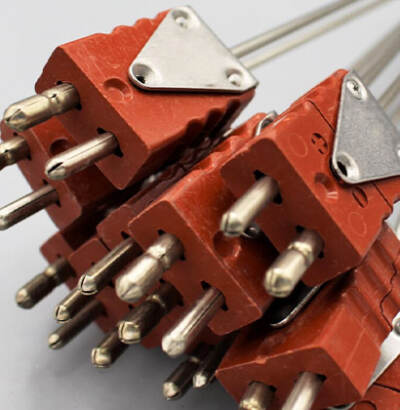
Thermocouples are simple, reliable, and versatile, which makes them a go-to solution in countless industrial applications.
Thermocouples function through a well-established physical principle known as the Seebeck effect. When two dissimilar metals are joined to form a closed circuit and the two junctions are held at different temperatures, a voltage is produced. This voltage is directly related to the temperature difference across the circuit.
Thermoelectric Measurement Process:
- A voltage is generated at the junction due to the movement of charge carriers (electrons or holes) caused by the temperature gradient.
- This small voltage (in millivolts) is measured at the cold junction and interpreted as a temperature value.
Since thermocouples measure only temperature difference, cold junction compensation (CJC) is used to reference measurements accurately to known ambient conditions.
This principle allows thermocouples to operate without external power and makes them suitable for rugged, high-temperature applications.
Yes—thermocouples can degrade over time due to environmental and mechanical stress. While they are designed for durability, their accuracy and responsiveness can decline, especially in high-temperature or corrosive applications.
Common Causes of Failure
- Oxidation and corrosion from heat and gas exposure
- Mechanical damage from vibration, impact, or improper handling
- Drift, where prolonged use changes the thermoelectric properties of the metals
- Contamination from chemicals or metal vapors altering sensor output
- Unstable or fluctuating readings
- Sudden drops or jumps in temperature data
- Flat or no signal
- Conflicting readings between redundant sensors
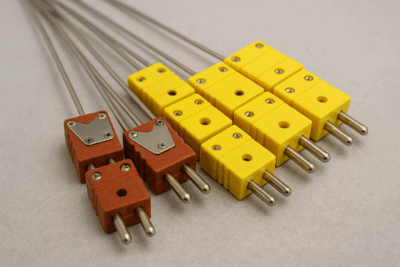
- Use the correct thermocouple type and sheath for your process
- Avoid bending or over-tightening during installation
- Perform regular calibration
- Replace sensors after major thermal events or if drift is detected
Thermocouple lifespan varies widely based on sensor type, temperature exposure, and environmental conditions. In controlled applications, service life may extend over a year; in harsh or high-temperature environments, it can be significantly shorter.
Selecting thermocouples for longevity involves matching sheath materials, sensor types, and configurations to the demands of each application.
Thermocouples are classified into standardized types based on their metal combinations. Each type offers unique temperature ranges, sensitivity, and environmental suitability.
| Type | Materials | Temp Range (°C) | Notes |
|---|---|---|---|
| K | Chromel / Alumel | -200 to 1260 | General purpose; widely used |
| J | Iron / Constantan | -40 to 750 | Low cost; limited high-temp use |
| T | Copper / Constantan | -200 to 370 | Excellent at low temps |
| E | Chromel / Constantan | -200 to 900 | High sensitivity |
| N | Nicrosil / Nisil | -200 to 1300 | Stable in oxidizing conditions |
| R | Pt-13%Rh / Pt | 0 to 1600 | Noble metal; accurate & stable |
| S | Pt-10%Rh / Pt | 0 to 1600 | Pharmaceutical & lab use |
| B | Pt-30%Rh / Pt-6%Rh | 0 to 1700 | Extreme temps; lab and aerospace |
Thermocouple wire and extension wire play a critical role in maintaining accurate temperature measurement throughout the entire sensing circuit. Different wire types, insulation materials, and conductor constructions are selected based on temperature range, environmental conditions, flexibility requirements, and installation constraints. Proper wire selection helps preserve signal integrity and long-term reliability in demanding industrial applications.
Common applications include:
- Heat treatment furnace profiling
- Aerospace and turbine testing
- Industrial process monitoring
- High-temperature furnace systems
- Custom thermocouple assemblies
Thermocouples are essential for monitoring and controlling temperature in critical industrial processes. High-performance sensors are commonly used in the following sectors:
- Heat Treatment: Furnace profiling, surface/core monitoring
- Oil & Gas: Pipeline, refinery, and flare stack monitoring
- Power Generation: Gas turbine and boiler sensors
- Aerospace: Engine, structural, and environmental testing
- Semiconductors: Precise thermal control during wafer fabrication
Industrial-grade thermocouples are engineered to handle high temperatures, thermal cycling, mechanical vibration, and corrosive environments.
Certain environments exceed the limits of standard sensor materials. Specialized thermocouples built with high-temperature alloys and custom insulations are used in extreme applications such as:
- Jet and rocket engine testing
- Vacuum and inert-atmosphere furnaces
- Molten metal and glass processing
Materials like tungsten-rhenium, molybdenum, and sapphire insulation are often selected to meet the required performance.
In harsh industrial environments, standard thermocouple constructions may not provide the durability needed for long-term performance. Mineral insulated (MgO) thermocouples are built with compacted magnesium oxide insulation and a protective metal sheath, allowing them to withstand high temperatures, vibration, pressure, and aggressive operating conditions while maintaining reliable temperature measurement.
Common advantages include:
- Fast thermal response
- Excellent mechanical strength
- Resistance to vibration and thermal cycling
- Reliable performance in high-temperature applications
- Flexible configurations for complex installations
MgO thermocouples are widely used in aerospace testing, heat treatment systems, industrial furnaces, and other demanding applications where durability and performance are critical.
Types R, S, and B thermocouples use platinum-rhodium alloys to deliver high accuracy and long-term stability in elevated temperatures.
Benefits:
- Superior chemical resistance
- Long service life in controlled environments
- Consistent performance over time
Many facilities support these high-value sensors through recycling and precious metal reclamation programs.
Noble metal thermocouples contain valuable platinum and rhodium materials that can often be recovered and reused at the end of their service life. Precious metal reclamation programs help facilities recover platinum value, reduce replacement costs, and support more sustainable long-term thermocouple management.
These programs are especially valuable for industries that rely on platinum-based Type R, S, and B thermocouples in high-temperature furnace, aerospace, and heat treatment applications.
Standard solutions don’t always meet real-world conditions. Custom thermocouples allow for greater precision, durability, and integration within specific systems or environments.
Customization Options:
- Sheath material and diameter
- Junction type (grounded, ungrounded, exposed)
- Mounting hardware, enclosures, and connectors
- Calibration to industry standards
Custom thermocouples ensure better fit, longer life, and optimized performance for unique process requirements.
Traceability is critical in industries where measurement accuracy must be documented and verified.
Calibration services aligned with the following standards ensure compliance:
- ISO/IEC 17025 (accredited calibration lab)
- ISO 9001 (quality management)
- AS9100D (aerospace quality systems)
These certifications support regulatory and quality assurance requirements in aerospace, pharmaceuticals, and energy.
Aerospace systems demand high reliability, temperature range, and mechanical durability. Thermocouples are used in:
- Gas path probes for turbine engines
- Environmental testing chambers
- Spacecraft and propulsion monitoring
Sensors must resist vibration, thermal cycling, and chemical exposure while meeting the industry’s most stringent accuracy and traceability standards.
Choosing the Right Thermocouple
Selecting the right thermocouple depends on the operating temperature, environmental conditions, accuracy requirements, and material compatibility. Different thermocouple types are manufactured using specific alloy combinations that influence temperature range, stability, corrosion resistance, and long-term performance.
| Type | Materials | Best For |
|---|---|---|
| K | Chromel / Alumel | General industrial and high-temperature applications |
| J | Iron / Constantan | Lower-temperature industrial processes |
| T | Copper / Constantan | Cryogenic and low-temperature applications |
| E | Chromel / Constantan | Applications requiring high sensitivity |
| N | Nicrosil / Nisil | Improved stability in high-temperature environments |
| R | Platinum-13% Rhodium / Platinum | Precision furnace and heat treatment applications |
| S | Platinum-10% Rhodium / Platinum | Precision furnace and aerospace applications |
| B | Platinum-30% Rhodium / Platinum-6% Rhodium | Extreme high-temperature environments |
| C | Tungsten-Rhenium | Vacuum furnaces and ultra-high-temperature applications |
| MgO | Mineral-insulated metal-sheathed assemblies | Harsh environments with vibration and thermal cycling |
Conclusion
Thermocouples remain an essential technology for accurate, real-time temperature measurement across a wide range of industrial environments. Understanding their types, use cases, and lifecycle considerations ensures better system performance, safety, and efficiency.
Whether selecting a standard sensor or specifying a custom design, careful alignment with application demands is key to long-term reliability and performance.